SUBSCRIBE TO OUR EMAILS!
Subscribe to Esplanade emails and be the first to know about new exhibitions, shows, programs and experiences! Get the best seat in the house with exclusive pre-sales and much more!

Interoceptive Sensing
Kara Sloan
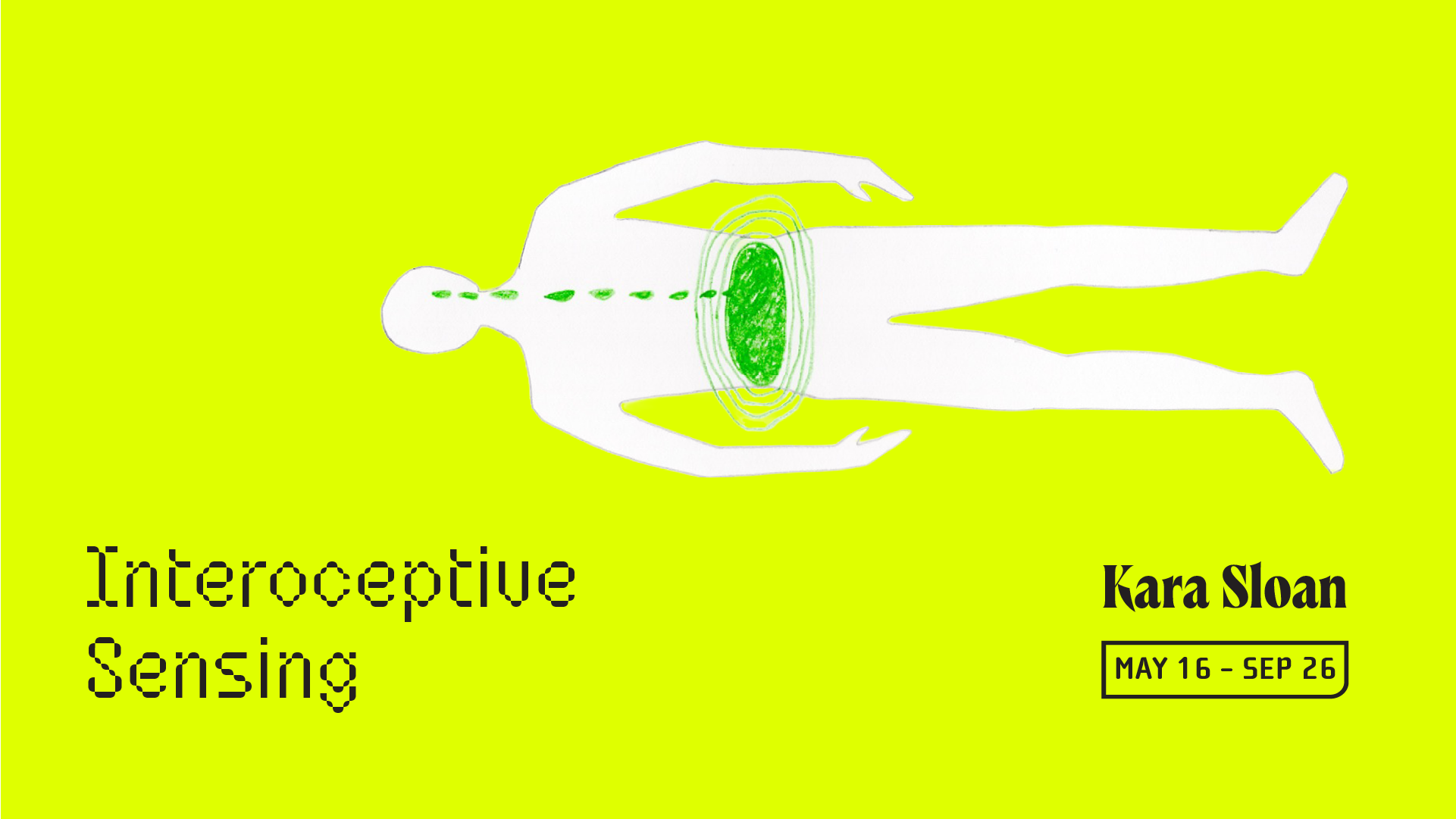
In Interoceptive Sensing, Kara Sloan presents visual interpretations of her body’s internal landscape, newly reconfigured by onset chronic illness. Like sight and touch, interoception refers to another of the body’s senses. It interprets internal signals and communicates actions towards regulation: hunger pangs cue eating, an itch prompts a scratch. But what were to happen if those signals became haywire? How do you begin to re-orient yourself and navigate back to a balanced state of being? Kara responds by going in search of a map.
Wayfinding begins with an understanding of the immediate environment. The artist conducts preliminary research by locating and tracking where certain symptoms appear throughout her body. Observed sensations are translated into textures, shapes, and colours that are then mapped onto figurative silhouette drawings. Kara then uses the gathered data to model this new topography in textile and ceramic. In their sculptural forms, these observed sensations are given the ability to droop, stretch, and stab in tangible space. The mediums are chosen intentionally to reflect the quiet patience and careful handling needed to tend to a body with chronic illness.
The body’s internal environment can also be understood by how it chooses to keep time. Time is commonly experienced as something linear and predictable. Alternatively, Kara’s work is located and produced within crip time, described by theorist Alison Kafer as the way in which time is experienced by disabled bodies. Characterized by disruption, delays, and time travel, crip time affords the navigator an opportunity to be present. A new intimacy with the self is cultivated in gentle exploration.
Interoceptive Sensing invites sensitivity to our internal geometries and reminds us of curiosity and care as navigational strategies towards reorientation. Within disruption, there is always rest, and a moment for profound self-discovery and understanding.
Curated by Thea Sleight, Esplanade Arts & Heritage Centre
Artist Bio
Kara Sloan is a multidisciplinary artist and educator honored to live and work on the traditional territories of the Siksikaitsitapii, or Blackfoot Confederacy. She holds a Bachelor of Fine Arts (BFA) and a Bachelor of Education (BEd) from the University of Lethbridge, receiving both the Fine Arts Faculty Award and the Abbondanza Fine Art Scholarship. She has completed several curatorial projects, as well as recent residencies at the Gushul Studio (Blairmore), and Medalta Historic Clay District (Medicine Hat).
Kara’s work is rooted in an ongoing exploration of the body’s role in perception, interpretation, and understanding of the world. Her drawing practice explores the visual expression of mental and emotional processing of relationships and social structures, whereas her drawing-informed sculptural practice investigates one’s ability to understand the internal body.
Her experience in athletics, both as an athlete and a coach, has significantly influenced her artistic journey. The spatial awareness inherent in sports, combined with her understanding of how bodies interact with others and their environment, have expanded and deepened her conceptual framework. As an educator, Kara developed a keen awareness of the ways in which perception, interaction, and personal experience intersect. The relationships between the body, space, and materiality are central to her exploration of perception.